Multiscale Modeling of Materials LabSan Diego State University

Resources

Experimental and computing resources.

Shared infrastructure supporting M3 Lab experiments, simulations, data analysis, and computational materials research.

Experimental Resources

Customized and lab-developed experimental platforms supporting Xu group studies of field-assisted processing, in-situ microscopy, thermal-mechanical coupling, and rapid high-temperature testing.

Real benchtop ENP system overview with pulsed-current supply, fixture board, monitoring electronics, and oscilloscope.
Real lab image: full benchtop ENP setup with pulsed-current supply, fixture board, measurement electronics, and oscilloscope.
Real lab image

Electro-Nano-Pulsing (ENP) Advance 4X Platform

Nanosecond pulsed-current processing for grain-boundary engineering.

The Xu group develops customized electro-nano-pulsing platforms for grain-boundary engineering in metallic materials. The ENP Advance 4X system applies programmable nanosecond-scale current pulses to small metallic specimens to probe localized electrical, thermal, and electron-wind effects at grain boundaries.

  • Ultra-intense nanosecond pulsed-current processing
  • Four-pair copper feed-plate architecture on alumina-ceramic PCB
  • Removable central chamber for inert Ar or liquid-nitrogen operation
  • Designed for small metallic strip specimens
  • Supports studies separating Joule-heating and electron-wind effects
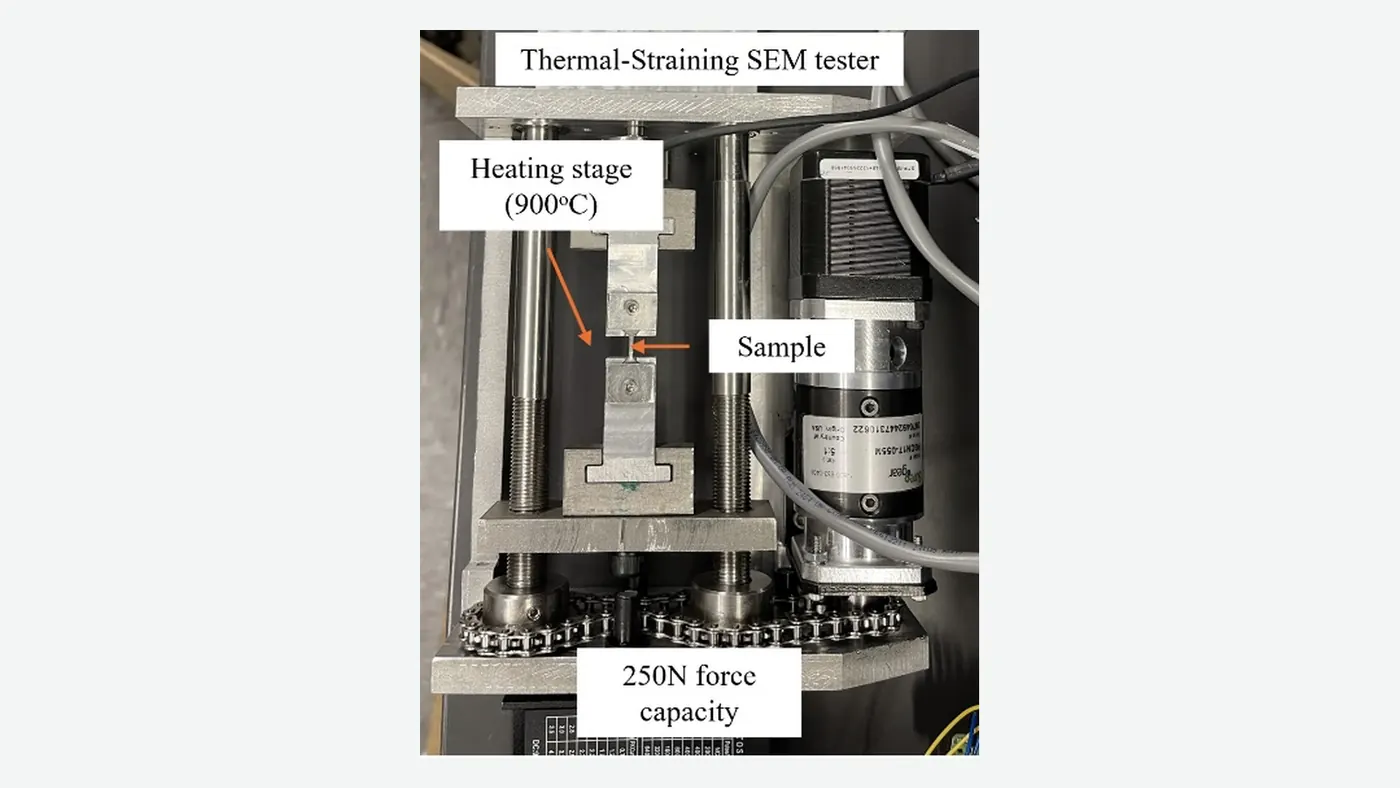
Real thermal-straining SEM tester with heating stage, sample position, and force-capacity label.
Real lab image: thermal-straining SEM tester with heating stage, sample zone, and mechanical loading hardware.
Real lab image

Custom SEM In-Situ Thermo-Mechanical Testing Device

Lab-made fixture for direct SEM observation during thermal-straining.

The group has developed a customized SEM-compatible mechanical testing device for in-situ thermal-straining studies. Paired with an SEM heating stage, the fixture supports direct observation of deformation and microstructural evolution under coupled thermal and mechanical loading.

  • Lab-made SEM-compatible mechanical fixture
  • Compatible with in-situ SEM imaging workflows
  • Pairs with a heating stage for thermal-straining experiments
  • Supports observation of strain localization, cracking, and interface evolution
  • Adaptable to customized specimen geometries and loading configurations
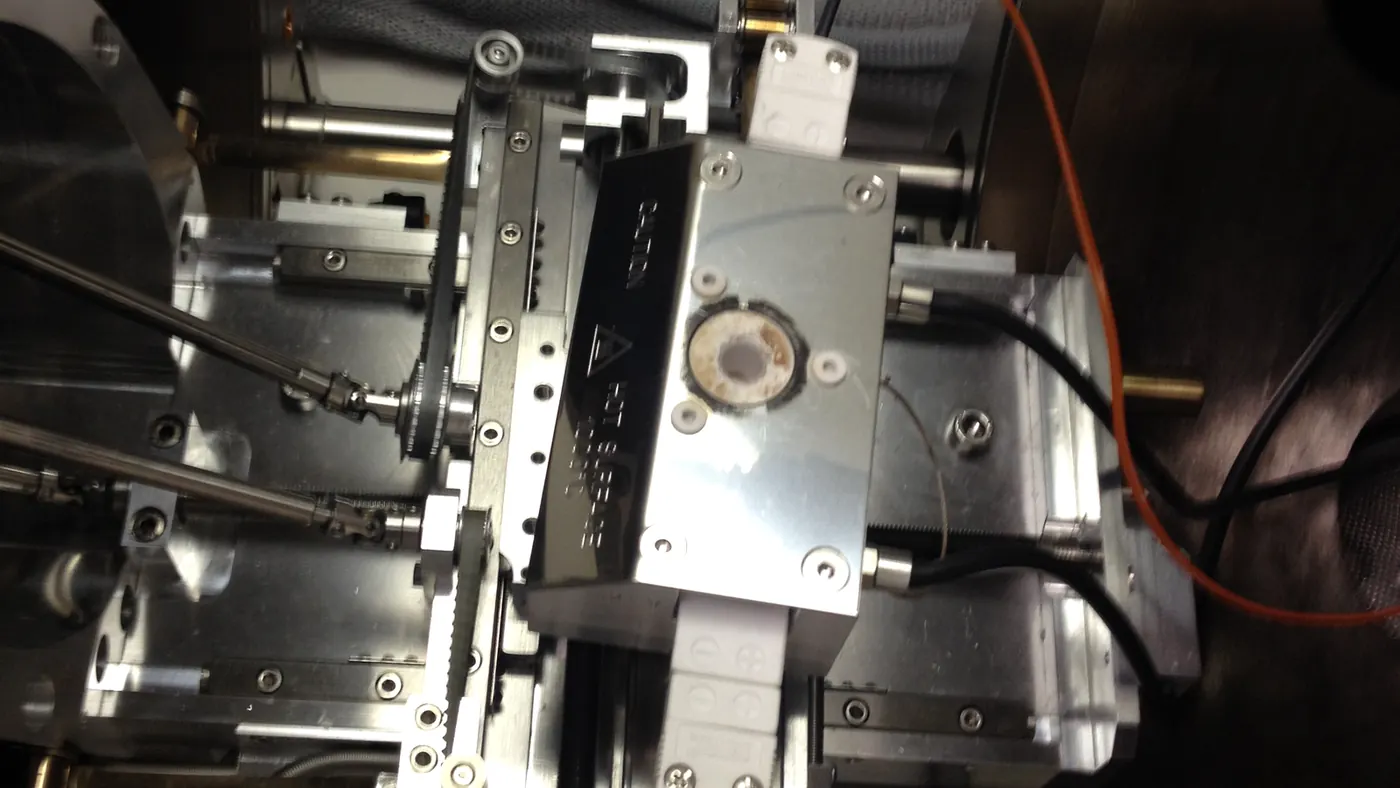
Real SEM hot-stage assembly installed inside an SEM chamber with heater surface and electrical connections.
Real lab image: SEM hot-stage assembly installed in the SEM chamber for elevated-temperature experiments.
Real lab image

SEM High-Temperature Heating Stage / Furnace Capability

Elevated-temperature SEM observation and thermal-processing studies.

The group uses high-temperature SEM-stage capabilities to observe microstructural evolution during thermal exposure and coupled thermal-mechanical loading. These resources support SEM-based high-temperature and flash-sintering studies of ceramic and metallic materials.

  • SEM-based observation during controlled heating
  • Integrates with customized mechanical loading hardware
  • Supports thermal exposure, thermal-straining, and flash-sintering studies
  • Tracks morphology, cracking, and grain-boundary behavior
  • Apreo 2-compatible heating-stage path with detector compatibility considerations
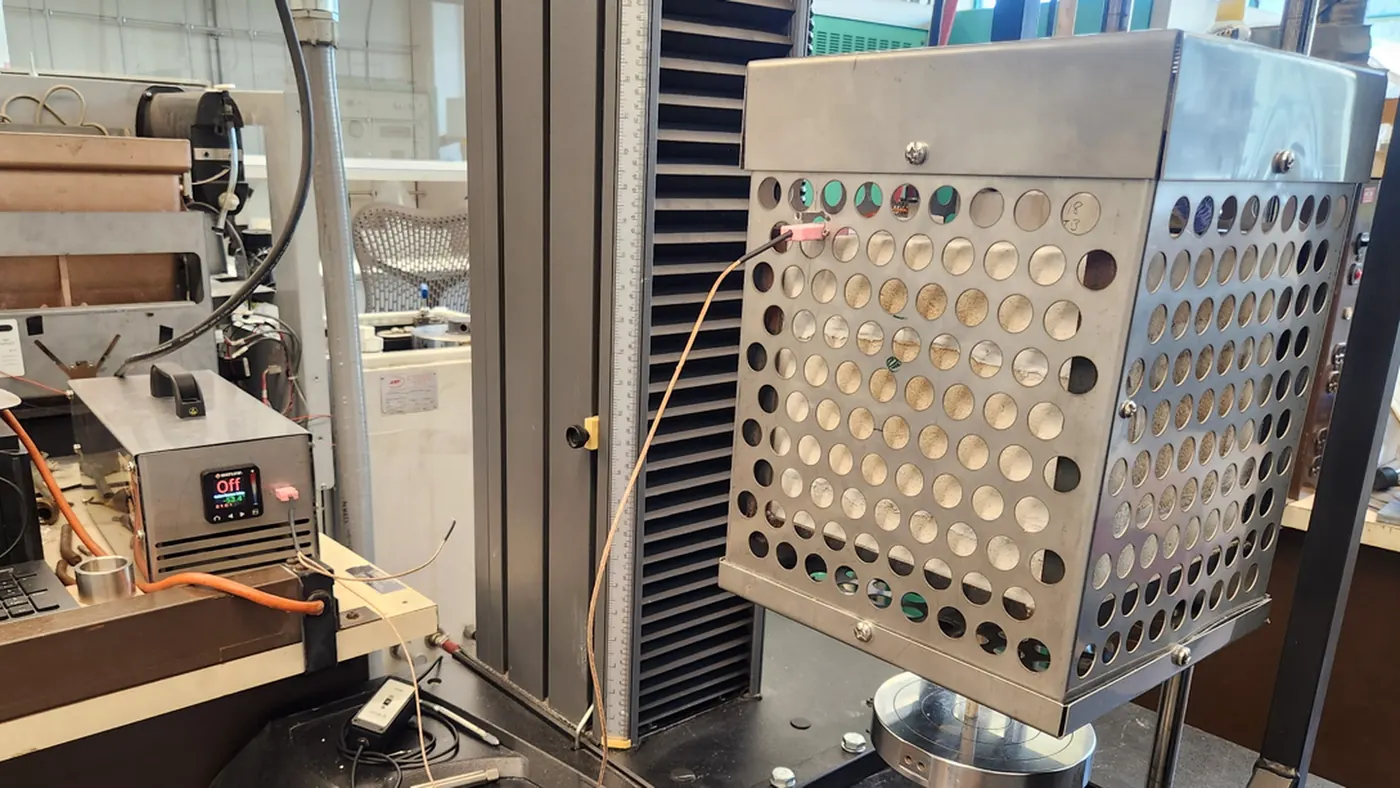
Real rapid-heating furnace assembly mounted in an Instron mechanical testing frame.
Real lab image: custom rapid-heating furnace integrated with an Instron frame for coupled thermal-mechanical testing.
Real lab image

Custom Rapid-Heat Tube Furnace / ENP-Compatible Rapid Heating System Integrated with Mechanical Testing

Fast high-temperature experiments under mechanical loading.

The Xu group operates a custom rapid-heat tube furnace designed for thermal-elastic processing and high-temperature mechanical testing. The system integrates with an Instron universal testing machine to enable coupled heating and mechanical loading of small cylindrical specimens.

  • Custom-built compact rapid-heat tube furnace
  • Designed to bolt directly to an Instron universal testing machine
  • Four silicon-carbide heating elements with SCR power control
  • Watlow PM6+ PID control with Type N thermocouple
  • Can also operate as a standalone table-mounted furnace

Computing Resources

The Xu Research Group uses high-performance computing resources at San Diego State University to support computational materials science, atomistic simulations, molecular dynamics, data analysis, and simulation-driven materials design.

SDSU High Performance Computing Cluster

The group uses SDSU High Performance Computing Cluster resources for CPU- and GPU-based computational research. SDSU HPCC infrastructure provides shared high-performance computing nodes, GPU-enabled resources, and networked storage capacity that support large-scale simulations and data-intensive post-processing.

Resource overview

SDSU TIDE Research Cluster

The group also uses SDSU Technology Infrastructure for Data Exploration (TIDE) research cluster. TIDE provides SDSU researchers access to research-class CPU, GPU, and storage resources. These resources support containerized research workflows, including computational materials modeling, atomistic simulations, data analysis, and machine-learning-assisted materials research.

Resource overview