San Diego State University / Mechanical Engineering
Multiscale Modeling of Materials Lab
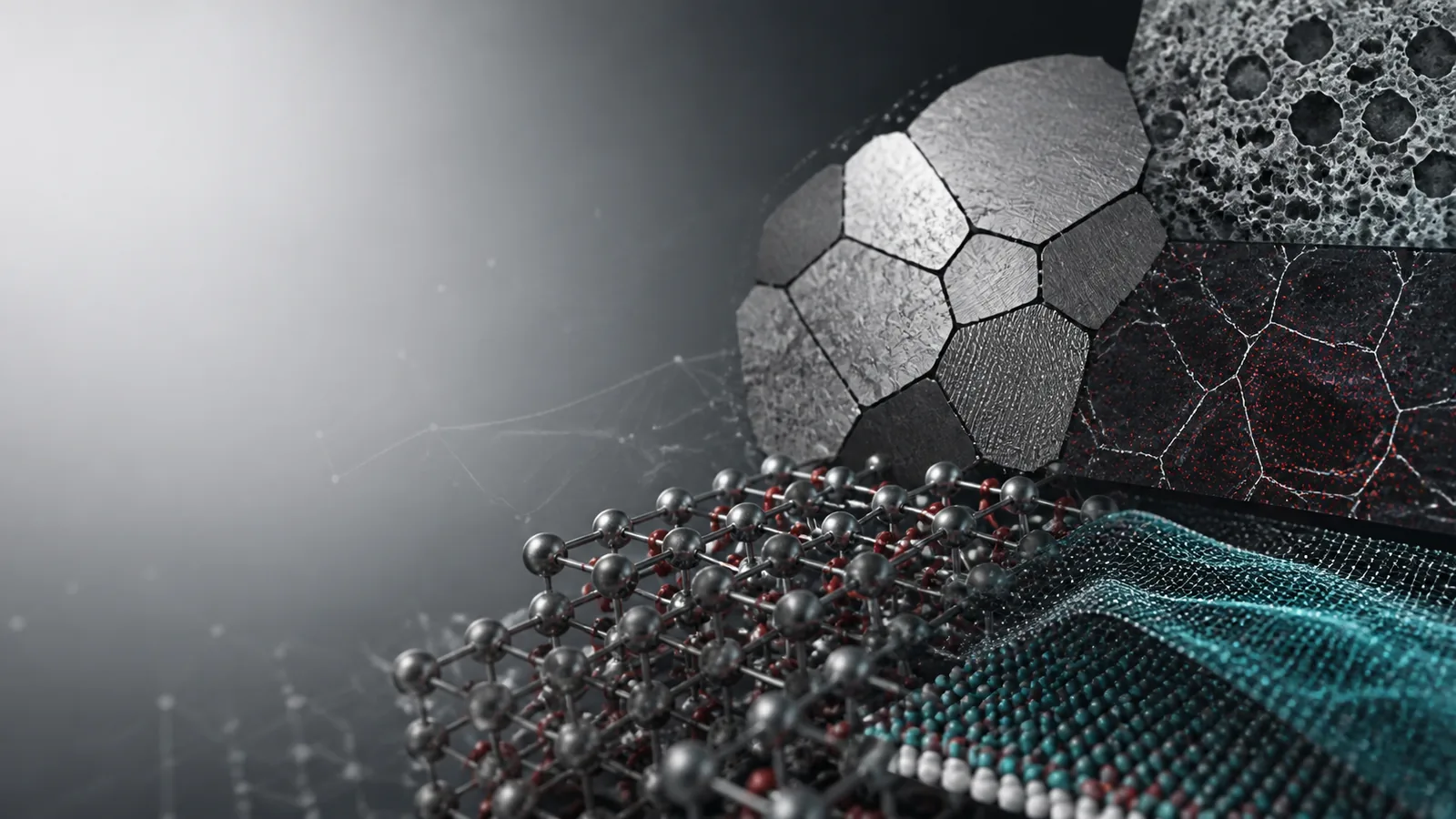
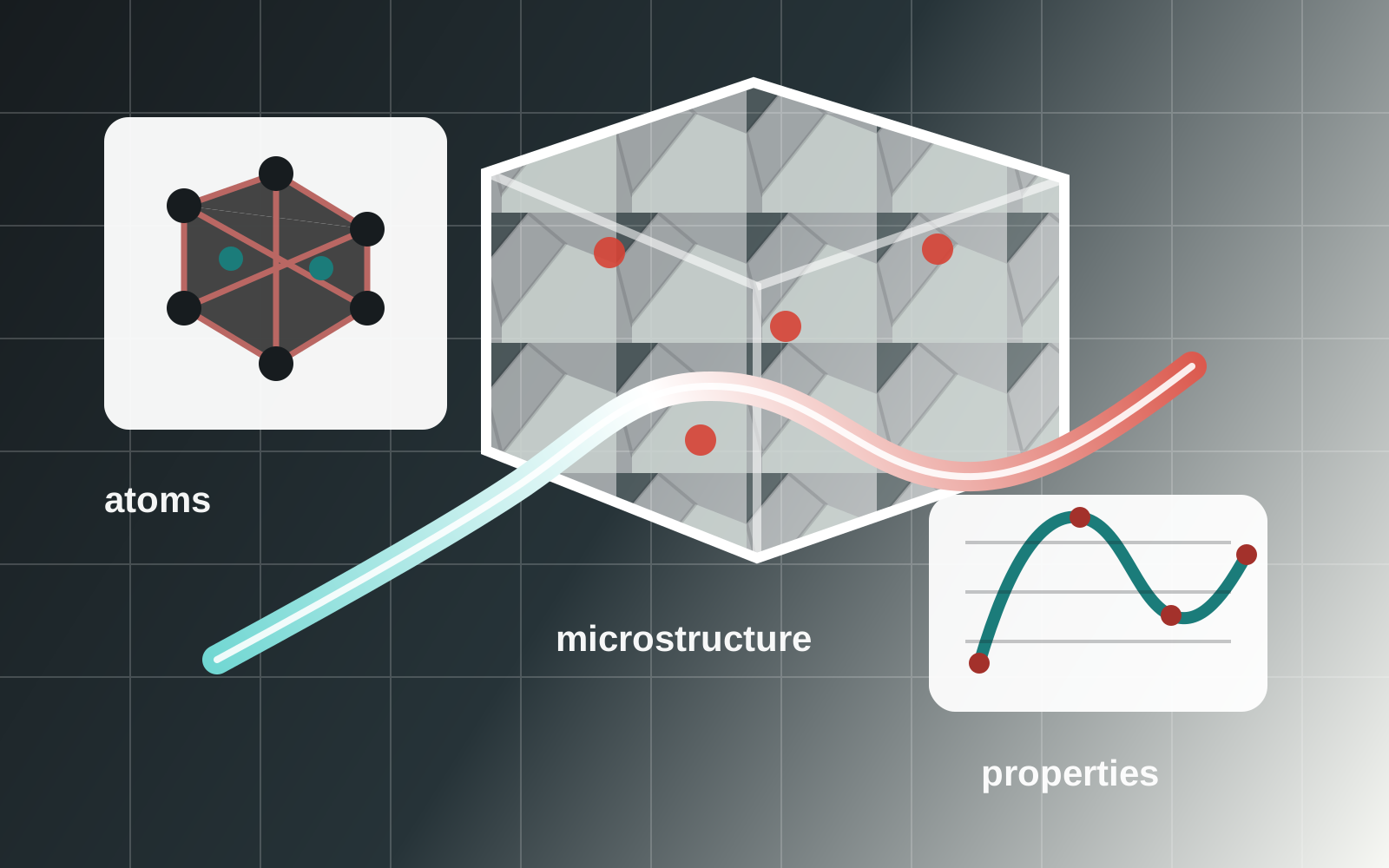
We combine simulation, microstructure characterization, and field-assisted processing to understand and design materials from atoms to engineered structures.
Materials questions, modeled and tested across scales.
Computational materials science with experimental anchors.
The M3 Lab studies nanoscale and microstructure mechanisms in metals, ceramics, composites, and field-assisted processing. We connect computational models with experimental evidence to understand how processing changes material structure and properties.
How do electric fields and nanosecond pulses alter grain-boundary structure and mobility?
What mechanisms control flash sintering and current-driven ceramic processing in 8YSZ?
How can atomistic, continuum, and finite-element models pass useful information across scales?
Which microstructure descriptors best predict deformation, diffusion, and processing response?
Research
Research projects.
Current projects connect atomistic simulation, microstructure characterization, field-assisted processing, and data-driven materials design.
AI/ML
AI/ML for Materials Microstructure and Processing
Data-driven models can help connect processing conditions, microstructure descriptors, and material response.
The lab uses machine-learning ideas to accelerate multiscale modeling and identify interpretable links among simulated microstructures, processing routes, and properties.
Electro-Nano-Pulsing and Grain Boundary Engineering
Nanosecond electrical pulses may offer a route to manipulate grain boundaries and design stronger materials.
This project studies whether short, intense electrical pulses can alter grain-boundary structures and open new processing pathways for advanced materials. The work combines multiphysics modeling, nanoscale mechanism hypotheses, and microstructure evidence.
Methods
finite element analysisatomistic modelingmicroscopyelectrical pulsing
Flash Sintering and Current-Driven Ceramic Processes
Field-assisted ceramic processing can accelerate densification and reveal new coupling among current, heat, defects, and microstructure.
The lab studies 8 mol% yttria-stabilized zirconia and related ceramic systems to understand how electric fields, temperature, and microstructure interact during rapid sintering.
Microscopy, diffraction, and three-dimensional reconstruction provide evidence for processing-structure-property relationships.
Experimental characterization grounds the lab's modeling work, helping the group compare mechanisms against microstructure, deformation, and processing evidence.
Computation connects electronic, atomic, microstructural, and component scales for materials design.
The M3 Lab develops and applies modeling workflows across length scales, using simulation to interpret mechanisms and connect materials structure to performance.
Methods
DFTmolecular dynamicsfinite element analysiscontinuum modeling
Localized Grain Boundary Engineering via Thermal-Elastic Processing (TEP)
W. Xu, M. Alfaro, R. Jiang, S. Sotero, J. Burns, A. Contreras, C. Delaney, C. Foronda, and M. Pavao. TMS 2026 155th Annual Meeting and Exhibition Supplemental Proceedings, 763-774.
Localized plasticity, transformation, and martensite cracking in hydrogen-charged metastable austenitic stainless steel studied by in situ electron channeling contrast imaging
M. Koyama, Z. Yang, W. Xu, and E. Akiyama. Materials Characterization, Volume 233, Article 116127.
Current and recent awards supporting materials modeling, processing, characterization, and education innovation.
CSU GUIDE - AI-JUDGE: Cultivating Computational Judgment in Undergraduate STEM via Intentionally Fallible Generative AI
California State University Chancellor's Office. PI: Wenwu Xu (San Diego State University); Co-PIs: Luwen (Vivian) Huangfu (San Diego State University) and Ashley Ringer McDonald (California Polytechnic State University, San Luis Obispo). Amount: $80,000. Period: Aug. 15, 2026-Aug. 14, 2027. This multi-campus project will develop and validate AI-JUDGE to help undergraduate students identify and correct scientifically inaccurate AI-generated simulation code. It will support six paid undergraduate research assistants, engage approximately 100 students through course-integrated activities, and prepare a follow-on NSF Improving Undergraduate STEM Education proposal.
ASCEND Research and Leadership Program - Alliance of Hispanic Serving Research Universities (HSRU)
PI: Wenwu Xu. Amount: $199,772. Period: 2026-2027. Title: Thermal-Elastic Processing (TEP) for Defense-Relevant Localized Interface Engineering via Coupled Atomistic Modeling and in Situ Electron Microscopy. This project develops TEP as a localized interface-engineering strategy for defense-relevant structural metals, coupling atomistic modeling with in situ electron microscopy. The project is part of the inaugural ASCEND Research and Leadership Program cohort.
W. M. Keck Foundation - New Materials Processing via Electro-Nano-Pulsing (ENP)
PI: Elisa Torresani; Co-PIs: Wenwu Xu and Eugene Olevsky. Amount: $1,200,000. Period: 2026-2028. This project develops electro-nano-pulsing as a new materials-processing approach for rapid, localized microstructural transformation and grain-boundary engineering in advanced materials.
Molecular Sciences Software Institute. Period: 2025-2027. Project: Transforming Materials Modeling Education through LLM-Assisted Coding and HPC Integration for SDSU's Doctoral Engineering Program. This fellowship supports curriculum transformation in computational molecular/materials science through programming, data competency, computing, mentorship, and reusable curricular module development.
STEM-NET Faculty Fellows Grant Program, California State University Chancellor's Office. Faculty Fellow: Wenwu Xu. Award No. 132597-FFA-2025-1-SAN DIEGO. Amount to SDSU: $7,478, with additional institutional support. Period: 2025-2026. This fellowship supports CSU STEM faculty in developing collaborative research and education proposals, strengthening campus scholarship, and advancing STEM-NET's systemwide mission.
NSF - ECCENTRIC: A Mechanism of Flash Sintering of Ionic Ceramics
PI: Wenwu Xu; Co-PI: Eugene Olevsky. Amount: $328,397. Period: 2019-2023. This project investigated the mechanisms of flash sintering in ionic ceramics through atomistic modeling and experimental studies of electric-field-assisted sintering processes.
DOE - Tailoring Grain-Boundaries by Electro-Nano-Pulsing (ENP)
PI: Eugene Olevsky; Co-PI: Wenwu Xu. Award No. DE-SC0022244. Amount: $467,000. Period: 2021-2024. This project developed electro-nano-pulsing approaches for localized grain-boundary engineering and rapid materials processing, supported by multiscale modeling and experiments.
PI: Wenwu Xu. Amount: $15,000. Period: 2024. Title: Atomistic Structural Evolution of Electro-Nano-Pulsing Processing of Metals by Computer Simulation. This project supported atomistic computer simulations of structural evolution in metals under electro-nano-pulsing, including graduate-student support and computational resources for ENP modeling.
PI: Wenwu Xu. Amount: $10,000. Period: 2019-2020. Title: A Unique Experimental Apparatus for In-Situ Nanoscale Imaging of Electric Field Assisted Sintering Process. This project developed a coupled experimental and imaging setup for in-situ nanoscale SEM characterization of electric-current-assisted sintering processes, using yttria-stabilized zirconia as a benchmark material system.
PI, graduate students, undergraduate researchers, and alumni.
The M3 Lab brings together graduate students, undergraduate researchers, alumni, and collaborators working across modeling, processing, and characterization.
Principal Investigator
Principal Investigator
Wenwu Xu
2017-present
Dr. Wenwu Xu received his Ph.D. in Materials Science and Engineering from Beijing University of Technology (China) in 2011. He then pursued postdoctoral research at Friedrich-Schiller-Universität Jena (Germany) in 2012 and The University of Manchester (U.K.) in 2013-2015. In 2016, he joined the Department of Materials Science and Engineering at the University of California, Merced as a postdoc and then as a lecturer. In August 2017, Dr. Xu joined the Department of Mechanical Engineering at San Diego State University as an Assistant Professor. In 2023, Dr. Xu became a tenured Associate Professor. He directs the Multiscale Modeling of Materials Lab, leading research that connects computational materials science, microstructure characterization, field-assisted processing, and nanoscale structure-property relationships.
DFTMDFEAmicroscopyflash sinteringENPAI/ML
My journey to SDSU
From Hunan to San Diego: a playful animated look at my education, research, and teaching journey. 1 min 25 sec — press play to watch.
Read the journey as a text timeline
1982–1996Yiyang, Hunan · Growing up in China
1996–1999Xiangtan · School years
1999–2003Jishou University
2003–2006Guilin University of Technology
2006–2009Beijing University of Technology · Doctoral studies
2009Jena, Germany · Visiting research
2011Beijing University of Technology · PhD awarded
2012Friedrich Schiller University Jena · Postdoctoral research
2013–2015The University of Manchester · Research in the United Kingdom
2015University of California, Berkeley · A California visit
2015The University of Manchester · Back to Manchester
2016–2017University of California, Merced · Research and teaching
2017–presentSan Diego State University · Mechanical Engineering, M3 Lab
My conference journey
From doctoral research to presentations and symposium leadership: a map-led retrospective of conference activities, 2008–2026.
Project: Tailoring grain boundaries by electro-nano-pulsing
Zeshan studies electro-nano-pulsing and grain-boundary engineering using atomistic molecular dynamics and computational materials workflows.
MDENPgrain boundariesLAMMPSOVITOPython
M.S. Student
Jose Morales
2026-present
Project: Hydrogen embrittlement mechanisms using molecular dynamics and grain-boundary free-volume modeling
Jose studies atomistic modeling of hydrogen effects, grain-boundary structures, and hydrogen embrittlement mechanisms.
MDhydrogen embrittlementgrain boundariesdefects
M.S. Student
Carson Sutton
2026-present
Project: Thermal-elastic-processing experiments and modeling
Carson studies thermal-elastic-processing, in-situ SEM experiments, and related modeling.
TEPin-situ SEMMDprocessing
M.S. Student
James Burns
2025-present
Project: Grain-boundary modeling for FEA/CPFEM and TEP-related modeling
James develops bimodal and serrated grain-boundary models for finite-element, CPFEM, and MD/FEA-based thermal-elastic-processing research. He has presented a poster at S3 and an oral presentation at TMS.
FEACPFEMMDgrain boundariesNeperAbaqus
M.S. Student
Rebeca Contreras
2026-present
Project: Flash-sintering mechanisms and ceramic sample preparation
Rebeca studies flash-sintering mechanisms through sample preparation, heat treatment, measurements, and SEM-based experimental characterization.
flash sinteringmicroscopysample preparationSEM
M.S. Student
Sherwin Navindaran
2020-present
Project: Nano-SCALPEL blood-clot removal research
Sherwin studies Nano-SCALPEL, nanoparticle spinning cutting, ablation, and lysis in plasma environmental liquid for blood clot removal. He was awarded the 2022 SDSU Master's Research Scholarship.
Nano-SCALPELnanomaterialscharacterizationmodeling
M.Eng. Student
Maraon Bani
2026-present
Project: Thermal-elastic-processing modeling and JOLT preliminary experimental setup development
Maraon develops modeling and analysis for thermal-elastic-processing research in coordination with experimental studies. Maraon also contributes to the development and construction of the JOLT project's preliminary experimental setup.
TEPJOLTmodelingexperimentsprocessing
Graduate Student
Adam Monroe
2026-present
Project: JOLT preliminary experimental setup development
Adam works on the development and construction of the JOLT project's preliminary experimental setup.
JOLTexperimentssetup development
Undergraduate Researchers
Undergraduate Researcher
Sky Soltero
2024-present
Project: Flash-sintering experiments of 8YSZ
Sky studies flash-sintering experiments of 8 mol% yttria-stabilized zirconia and related materials characterization. She attended TMS 2025 and ICME 2025 and is associated with a 2026 TMS flash-sintering presentation.
flash sinteringmicroscopysample preparation
Undergraduate Researcher
Marivel Alfaro
2024-present
Project: TEP experiments and in-situ SEM tensile testing
Marivel works on thermal-elastic-processing experiments, in-situ SEM tensile testing, and experimental characterization. She attended TMS 2025 and ICME 2025 and is associated with a 2026 TMS presentation on TEP experiments.
TEPin-situ SEMtensile testingcharacterization
Undergraduate Researcher
Theodore Norris
2025-present
Project: Flash-sintering mechanisms and experiments
Theodore studies flash-sintering mechanisms through experiments and materials characterization.
flash sinteringmicroscopycharacterization
Undergraduate Researcher
Adrian Contreras
2026-present
Project: TEP experiments and characterization
Adrian works on thermal-elastic-processing experiments and characterization and is listed through the MESA Summer Undergraduate Research Academy.
TEPcharacterizationprocessing
Undergraduate Researcher
Zachary McLaughlin
2025-present
Project: Electro-nano-pulsing technology
Zachary works on electro-nano-pulsing technology and related experiments.
ENPprocessingexperiments
Undergraduate Researcher
Henry Bahini
2026-present
Project: LLM-assisted modeling and validation for thermal-elastic processing
Henry works with James Burns on LLM-assisted modeling and validation workflows for thermal-elastic-processing research.
LLMmodelingFEATEP
Undergraduate Researcher / ME499 Student
Sean O'Grady
2026-present
Project: Electro-nano-pulsing technology
Sean works on electro-nano-pulsing technology as an undergraduate researcher and ME499 student.
ENPprocessingexperiments
Undergraduate Researcher
Ethan Pudasaini
2026-present
Project: Electro-nano-pulsing and thermal-elastic-processing experiments
Ethan works on electro-nano-pulsing and thermal-elastic-processing experiments, including sample preparation and experimental characterization.
ENPTEPprocessingexperiments
Undergraduate Researcher / ME499 Student
Nicolas Mosqueda
2026-present
Project: Electro-nano-pulsing technology
Nicolas works on electro-nano-pulsing technology as an undergraduate researcher and ME499 student.
ENPprocessingexperiments
Undergraduate Researcher
Anders Torgerson
2026-present
Project: Electro-nano-pulsing experiments with copper wires
Anders works on electro-nano-pulsing experiments with copper wires and supports experimental development and documentation.
ENPprocessingexperiments
IS
Undergraduate Researcher
Ian Saunders
2026-present
Project: Experimental materials processing
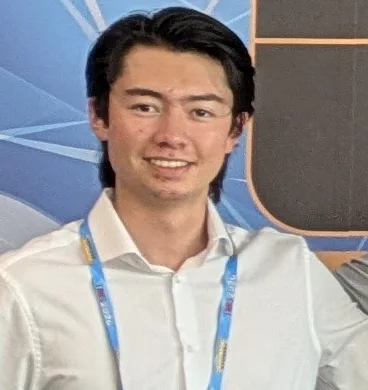
Ian is an undergraduate aerospace engineering student at San Diego State University who contributes to experimental materials-processing research in the M3 Lab.
processingexperiments
Undergraduate Researcher / MESA Summer Undergraduate Research Academy Intern
Isaiah Clemons
2026
Project: TEP experiments and characterization of Cu
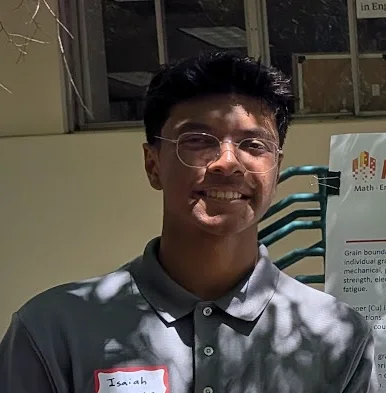
Isaiah works on thermal-elastic-processing experiments and characterization of copper as a 2026 MESA Summer Undergraduate Research Academy intern.
TEPcoppercharacterizationMESA
Alumni
Ph.D. Alumnus
Md. Shahrier Hasan
Graduated 2024
Project: Multiscale modeling and experimental investigations of mechanical deformation in nanocomposites
Current position: Postdoctoral Scholar, University of California, Los Angeles (as of 2026)
Shahrier worked on multiscale modeling and experimental investigations of mechanical deformation in nanocomposites. His graduate work included first-author and co-author journal papers and conference proceedings, departmental and senate qualifying exam milestones, the LBNL/SHI Sustainable Research Pathways summer internship, and an SDSU UGF JDP scholarship.
MDmicroscopynanomechanicsnanocomposites
M.S. Alumnus
Colin Delaney
Graduated 2025
Project: In-situ SEM study of flash-sintering mechanisms of ionic ceramics
Current position: Engineering role, General Atomics (as of 2026)
Colin studied in-situ SEM evidence for flash-sintering mechanisms in ionic ceramics. His graduate work included a co-authored TMS 2024 conference proceeding, a SoCal 2023 oral presentation at USC, and a TMS 2025 oral presentation on flash sintering.
flash sinteringmicroscopyceramics
M.S. Alumnus
Christopher Foronda
Graduated 2024
Project: Thermal-elastic-processing for tailoring metal grain-boundary morphologies
Current position: Quality Assurance Test Engineer II, NRS (as of 2026)
Christopher studied thermal-elastic-processing for tailoring metal grain-boundary morphologies and co-authored a refereed TMS 2024 conference proceeding.
TEPgrain boundariesprocessing
M.S. Alumnus
Junail Paule
Graduated 2024
Project: Machine-learning-based potential development for Ni and Cr metals
Current position: M.S. alumnus
Junail worked on machine-learning-based potential development for nickel and chromium metals.
AI/MLinteratomic potentialsmetals
GB
M.S. Alumnus
Gregory Berkeley
Graduated 2024
Project: Machine-learning-based multiscale modeling for metal-matrix nanocomposites
Current position: M.S. alumnus
Gregory worked on machine-learning-based multiscale modeling development for metal-matrix nanocomposites. He was awarded the SDSU RSCA student research fund in Spring 2021.
AI/MLMDmodeling
M.S. Alumnus
Kyrel Polifrone
Graduated 2023
Project: Flash-sintering mechanisms of ionic ceramics
Current position: M.S. alumnus
Kyrel studied flash-sintering mechanisms of ionic ceramics using atomistic modeling and experimental evidence. He received SDSU student research assistantship support in 2022, a 2023 SHI SRP summer internship, and authored or co-authored journal papers and a refereed conference proceeding.
flash sinteringMDmicroscopy
M.S. Alumnus
Gabriel Portillo Pauna
Graduated 2022
Project: 3D polycrystalline microstructure development for FEA modeling
Current position: Mechanical Design Engineer, General Atomics (as of 2026)
Gabriel further developed three-dimensional polycrystalline microstructures with specified grain-boundary components for finite-element analysis modeling.
FEAmicrostructuremodeling
M.S. Alumna
Michele Borba Pavao
Graduated 2022
Project: Local grain-boundary engineering by thermal elastic processing
Current position: M.S. alumna
Michele worked on local grain-boundary engineering by thermal elastic processing.
TEPgrain boundariesprocessing
M.S. Alumna
Katie Whitmore
Graduated 2021
Project: 3D polycrystalline microstructure development for mesoscale modeling
Current position: Mechanical and Thermal Engineer, Qualcomm (as of 2026)
Katie developed three-dimensional polycrystalline microstructures with specified grain-boundary components for mesoscale modeling.
FEAmicrostructuremodeling
M.S. Alumnus
Cameron Aires
Graduated 2020
Project: In-situ optical microscopy of metal deformation using an in-house micro-tensile tester
Current position: Design Engineer (as of 2026)
Cameron worked on in-situ optical microscopy of metal deformation using an in-house-designed micro-tensile tester.
microscopyinstrumentation
M.S. Alumna
Rachell Lee
Graduated 2019
Project: Finite-element modeling of Joule heating in 2D bimodal microstructured metals
Current position: Stress Analyst, General Atomics Aeronautical Systems (as of 2026)
Rachell modeled Joule heating in two-dimensional bimodal microstructured metals using finite-element analysis. She co-authored two peer-reviewed journal papers.
FEAgrain boundariesENP
Undergraduate Alumnus
Diego Cea
2026
Project: TEP experiments and characterization of Cu
Diego completed thermal-elastic-processing experiments and characterization of copper as a 2026 MESA Summer Undergraduate Research Academy intern.
TEPcoppercharacterizationMESA
Undergraduate Alumnus
Ethan Morrison
Graduated 2025
Project: Metal 3D printing technology development via induction heating
Current position: Project Engineer 1, Clark Pacific (as of 2026)
Ethan worked on metal 3D printing technology development via induction heating and attended TMS 2025.
3D printinginduction heatingprocessing
Undergraduate Alumnus
Jadyn Yamashita
2025
Project: Electro-nano-pulsing technology
Current position: B.S./M.S. Mechanical Engineering student, San Diego State University (as of 2026)
Jadyn previously worked on electro-nano-pulsing technology as an undergraduate researcher.
ENPprocessingexperiments
TD
Undergraduate Alumnus
Tyler De Silva
2024-2025
Project: Selective induction sintering 3D-printing method development
Current position: Mechanical Engineering graduate (as of 2026)
Tyler worked on selective induction sintering 3D-printing method development, including ME499 work in 2025.
3D printinginduction sinteringME499
JB
Undergraduate Alumnus
Jakob Bravo-Calderon
2024-2025
Project: ENP processing and sintering experiments
Current position: Undergraduate alumnus
Jakob worked on electro-nano-pulsing processing and sintering experiments, including ME499 work in 2025.
ENPsinteringME499
Undergraduate Alumnus
Simhal Maharaj
2024-2025
Project: In-situ SEM imaging of metal deformation
Current position: Field Service Engineer, Solar Turbines (as of 2026)
Simhal worked on in-situ SEM imaging of metal deformation processes.
in-situ SEMdeformationmetals
Undergraduate Alumnus
William Fischer
2024-2025
Project: In-situ tensile tester development and SEM imaging of metal deformation
Current position: Undergraduate alumnus
William worked on in-situ tensile-tester development and in-situ SEM imaging of metal deformation.
in-situ SEMtensile testinginstrumentation
Undergraduate Alumna
Olivia Towers
2025
Project: FEA modeling of bi-modal polycrystalline metal
Current position: Incoming Scheduler I / EIT, Mortenson (as of 2026)
Olivia worked on finite-element modeling of bi-modal polycrystalline metal.
FEAmetalsmicrostructure
JR
Undergraduate Alumnus
Jorge Romo
2025
Project: Thermal-elastic-processing experiments
Current position: Undergraduate alumnus
Jorge worked on thermal-elastic-processing experiments.
TEPexperimentsprocessing
Undergraduate Alumnus
Wade Anderson
2024
Project: Sample preparation for ENP processing of aluminum metal
Current position: Fire Protection Engineer and Code Consultant / EIT (as of 2026)
Wade worked on sample preparation for electro-nano-pulsing processing of aluminum metal.
ENPsample preparationaluminum
GM
Undergraduate Alumnus
Gio Michale Conversano
2024
Project: ENP processing and sintering
Current position: M.S. Aerospace Engineering student, Cal Poly Pomona (as of 2026)
Gio worked on electro-nano-pulsing processing and sintering.
ENPsinteringprocessing
Undergraduate Alumnus
Allen Ortiz
2024
Project: In-situ SEM tensile tester
Current position: Aerospace Engineering student, University of Southern California (as of 2026)
Allen worked on the in-situ SEM tensile tester.
in-situ SEMtensile testinginstrumentation
Undergraduate Alumnus
Brandon Dimmick
2022-2023
Project: Thermal-elastic processing for localized grain-boundary engineering
Current position: Mechanical Engineering Student / Prototyping Engineer (as of 2026)
Brandon worked on thermal-elastic processing for localized grain-boundary engineering.
TEPgrain boundariesprocessing
Undergraduate Alumnus
Matthew Simon
2022-2023
Project: Thermal-elastic processing for localized grain-boundary engineering
Current position: Manufacturing Engineer, General Atomics Aeronautical Systems (as of 2026)
Matthew worked on thermal-elastic processing for localized grain-boundary engineering.
TEPgrain boundariesprocessing
Undergraduate Alumna
Lana Ayyash
2022-2023
Project: Experimental measurement of grain-boundary electrical resistance
Current position: Prototyping Engineer Intern, General Atomics Aeronautical Systems (as of 2026)
Lana worked on experimental measurement of grain-boundary electrical resistance in polycrystalline metals, including ME499 work measuring grain-boundary electrical resistivity of aluminum.
Project: Experimental measurement of grain-boundary electrical resistance
Current position: R&D Product Design Engineer, Callaway Golf (as of 2026)
Ethan worked on experimental measurement of grain-boundary electrical resistance in polycrystalline metals.
grain boundarieselectrical resistancemetals
Undergraduate Alumnus
Edgar Diaz
2021-2023
Project: Electro-nano-pulser system assembly and testing
Current position: SDSU IAC Center lead student, San Diego State University Industrial Assessment Center (as of 2026)
Edgar worked on assembly and testing of the electro-nano-pulser system for localized grain-boundary engineering.
ENPinstrumentationgrain boundaries
Undergraduate Alumna
Sabrina Abdelhamed
2023
Project: In-situ SEM of flash sintering of 8YSZ
Current position: Systems Engineer, Northrop Grumman (as of 2026)
Sabrina worked on in-situ SEM study of flash sintering of 8 mol% yttria-stabilized zirconia.
flash sinteringin-situ SEMceramics
MD
Undergraduate Alumna
Madison Darnauer
2023
Project: ReaxFF modeling of flash sintering of a 3-particle ZrO2 model
Current position: Aerospace Engineer, NAVAIR (as of 2026)
Madison worked on ReaxFF modeling of flash sintering in a three-particle zirconia model.
ReaxFFflash sinteringzirconia
Undergraduate Alumnus
Juan Roman
2023
Project: Finite-element exploration of a metal 3D-printing technology
Current position: Mechanical/Aerospace Engineering student; CNC/CMM Machinist student (as of 2026)
Juan worked on finite-element exploration of a metal 3D-printing technology.
FEA3D printingmetals
Undergraduate Alumna
Katie Hardwicke
2023
Project: Finite-element exploration of a metal 3D-printing technology
Current position: Process Improvement Engineer, General Atomics Aeronautical Systems (as of 2026)
Katie worked on finite-element exploration of a metal 3D-printing technology.
FEA3D printingmetals
Undergraduate Alumna
Madison Rogers
2023
Project: Measuring grain-boundary electrical resistivity of aluminum metal
Current position: Systems Engineer, Raytheon (as of 2026)
Madison worked on measuring grain-boundary electrical resistivity of aluminum metal.
grain boundarieselectrical resistivityaluminum
Undergraduate Alumnus
Pablo Hinojosa Amaya
2023
Project: Finite-element modeling for a bimodal grain-boundary serration model
Current position: Bioengineering student, San Diego State University (as of 2026)
Pablo worked on finite-element modeling for a bimodal grain-boundary serration model.
FEAgrain boundariesmicrostructure
BJ
Undergraduate Alumnus
Billal Jamshady
2023
Project: Bimodal grain-boundary serration model creation
Current position: Sales / mentorship role, Glorifying Christ (as of 2026)
Billal created a bimodal grain-boundary serration model.
grain boundariesmicrostructuremodeling
Undergraduate Researcher
James Murray
2019-2021
Project: Ceramic 3D-printing technique using computer-aided modeling
Current position: Undergraduate alumnus
James worked on a novel ceramic 3D-printing technique using computer-aided modeling and virtual research workflows. He received SDSU Undergraduate Summer Research Program, SDSU RSCA student research fund, and LBNL/SHI Sustainable Research Pathways internship support.
3D printingceramicsmodeling
DU
Undergraduate Alumnus
Derek Uribe
2021
Project: FEA modeling of metal-matrix nanocomposites
Current position: Computer Science Graduate (as of 2026)
Derek worked on finite-element modeling of metal-matrix nanocomposites and received SDSU RSCA student research fund support in Spring 2021.
FEAnanocompositesmetals
Undergraduate Alumnus
Xavier Lovato
2019-2020
Project: Rotating magnetic-field generator integrated with Spero microscope
Current position: Manufacturing Engineer, General Atomics Aeronautical Systems (as of 2026)
Xavier worked on a rotating magnetic-field generator integrated with a Spero microscope and received SDSU student research assistantship support in Fall 2019.
instrumentationmicroscopymagnetic fields
Undergraduate Alumna
Sanam Nagvekar
2019-2020
Project: In-situ imaging apparatus for flash-sintering ceramics
Current position: Mechanical Engineer, Intuitive Surgical (as of 2026)
Sanam worked on an in-situ imaging apparatus for studying flash-sintering processes of ceramics and received SDSU student research assistantship support in Spring 2020.
flash sinteringinstrumentationceramics
Undergraduate Alumnus
Amaury Reed
2019-2020
Project: In-situ imaging apparatus for flash-sintering ceramics
Current position: GNC Engineer, Lockheed Martin (as of 2026)
Amaury worked on an in-situ imaging apparatus for studying flash-sintering processes of ceramics and received SDSU student research assistantship support in Spring 2020.
flash sinteringinstrumentationceramics
GL
Undergraduate Alumnus
Garrett Lee
2019-2020
Project: Molecular dynamics of flash sintering of YSZ
Current position: Undergraduate alumnus
Garrett worked on molecular dynamics of flash sintering of yttria-stabilized zirconia.
MDflash sinteringceramics
AA
Undergraduate Alumnus
Austin Arnold
2019-2020
Project: Molecular dynamics of flash sintering of YSZ
Current position: Mathematics Teacher, Health Sciences High School and Middle School (as of 2026)
Austin worked on molecular dynamics of flash sintering of yttria-stabilized zirconia.
MDflash sinteringceramics
JA
Undergraduate Alumnus
Jason Agtina
2020
Project: Tensile testing of aluminum metal using a micro-tensile tester
Current position: Engineering role, General Atomics (as of 2026)
Jason worked on tensile testing of aluminum metal using a micro-tensile tester.
tensile testingaluminuminstrumentation
NF
Undergraduate Alumnus
Nathan Fosgett
2020
Project: Sample preparation of aluminum metal for tensile testing
Current position: Undergraduate alumnus
Nathan worked on sample preparation of aluminum metal for tensile testing.
sample preparationtensile testingaluminum
Undergraduate Alumna
Roselynn Conrady
2020
Project: Virtual-reality development of automatic switching functions
Current position: Systems Engineer, Northrop Grumman (as of 2026)
Roselynn worked on virtual-reality development of automatic switching functions.
VRvisualizationsoftware
Undergraduate Alumna
Julia Gurfinkel
2020
Project: Sample design and prototyping for aluminum micro-tensile testing
Current position: Test Engineer, General Atomics Aeronautical Systems (as of 2026)
Julia worked on sample design and prototyping of aluminum metal for micro-tensile testing.
prototypingtensile testingaluminum
CE
Undergraduate Alumna
Claire Elizabeth
2020
Project: Synthetic blood-clot fabrication
Current position: Undergraduate alumna
Claire worked on synthetic blood-clot fabrication.
synthetic blood clotsfabrication
TE
Undergraduate Alumna
Theresa Escolano
2020
Project: Rotating magnetic-field device development
Current position: Undergraduate alumna
Theresa worked on rotating magnetic-field device development.
instrumentationmagnetic fields
Undergraduate Alumnus
Ken Ramirez
2017-2019
Project: MD simulations of fatigue deformation in bimodal microstructure metals
Current position: Engineering role, Solar Turbines (as of 2026)
Ken worked on molecular dynamics simulations of fatigue deformation in bimodal microstructure metals. He was second author on one peer-reviewed journal paper and received SDSU Undergraduate Summer Research Program support in 2018.
MDfatiguemetalsmicrostructure
Undergraduate Alumna
Sarah Gomez
2017-2019
Project: Molecular dynamics simulations of nanocrystalline metals
Current position: NASA civil servant, Launch Services Program, Vandenberg Space Force Base (as of 2026)
Sarah worked on molecular dynamics simulations of nanocrystalline metals and co-authored Prof. Xu's 2019 bimodal microstructure journal paper.
MDnanocrystalline metalsmicrostructure
Undergraduate Alumnus
Cole Waterhouse
2019
Project: Versatile mechanical testing device development assisted by CAD and modeling
Current position: Test Engineer, L3Harris Technologies (as of 2026)
Cole received SDSU SURP support to develop a versatile mechanical testing device for research applications assisted by CAD and modeling.
Dr. Wenwu Xu, Associate Professor of Mechanical Engineering at San Diego State University and director of the M3 Lab, is participating as a facilitator in the ASCENDᴿ Opportunity Advising Think Lab in the Washington, D.C., area, September 28–30, 2026. Organized by the Alliance of Hispanic Serving Research Universities (HSRU), the event includes a September 28 networking reception followed by two days of working sessions at the Virginia Tech Executive Briefing Center in Arlington, Virginia.
The Think Lab brings together university faculty, advisors, program leaders, students, and defense-sector partners to explore how institutions can help undergraduate and graduate students identify, prepare for, and pursue internships, fellowships, research experiences, and STEM career opportunities. Dr. Xu will facilitate discussions on Student Preparation & Competitiveness on September 29 and Regional Research Programs on September 30. Participants will exchange advising practices, examine barriers to student participation, and identify approaches that could be shared across HSRU institutions.
Dr. Xu's involvement builds on his participation in the inaugural ASCENDᴿ Research and Leadership Program, through which he leads a project on Thermal-Elastic Processing for defense-relevant interface engineering. The Think Lab connects this research engagement with his mentoring of undergraduate and graduate students.
Dr. Wenwu Xu, Associate Professor of Mechanical Engineering at San Diego State University and director of the M3 Lab, has joined the Editorial Board of Materials, published by MDPI. He will serve in the Materials Simulation and Design section for a renewable two-year term. In this role, he will support the section's development and serve as an Academic Editor for manuscripts within his areas of expertise. His research combines multiscale modeling and experimental characterization to investigate how processing shapes the microstructure and properties of metals, ceramics, and nanocomposites.
Dr. Wenwu Xu has been appointed as an affiliated faculty member of San Diego State University’s Computational Science Research Center (CSRC). Through this appointment, Dr. Xu will advise and support students in the SDSU–UC Irvine Joint Doctoral Program in Computational Science. The affiliation strengthens connections between the M3 Lab’s materials research and computational-science training, creating new opportunities for doctoral student mentorship and interdisciplinary collaboration.
Congratulations to Diego Cea and Isaiah Clemons for successfully completing their summer internship research program and presenting their Thermal-Elastic Processing research with the M3 Lab. Their project examined grain-boundary modifications in pure copper via thermal-elastic processing, connecting sample preparation, coupled thermal-mechanical testing, and microstructure characterization through the SDSU MESA Summer Undergraduate Research Academy.
Dr. Wenwu Xu received the FY2024 Japan Society for the Promotion of Science (JSPS) Invitational Fellowship for Research in Japan. The fellowship supported a 32-day research collaboration in Spring 2025 with host Professor Dr. Motomichi Koyama at Tohoku University, advancing international research exchange in materials science and modeling.
Current and archived faculty positions, conference symposia, journal collections, special issues, calls for papers, calls for abstracts, and professional service opportunities.
For students and faculty
DoW Opportunity Finder
Find funded defense-related internships, scholarships, fellowships, and research opportunities, with AI-assisted matching.
SDSU Assistant Professor of Mechanical Engineering
San Diego State University seeks a tenure-track assistant professor in advanced processing of powder materials, with a focus on sintering science and technology. The position begins in Fall 2027.
Applications received on or before November 30, 2026, will receive full consideration; the position remains open until filled. The successful candidate will work in SDSU's Powder Technology Laboratory, establish an externally funded research program, and teach undergraduate and graduate courses. A terminal degree in Mechanical Engineering, Materials Science and Engineering, or a closely related discipline is required by the date of hire. See the official posting (job no. 562953) for full qualifications and application instructions.
Conference Symposium / Call for AbstractsDeadline passed
Archived
TMS 2027 Symposium: Artificial Intelligence Applications in ICME
Abstracts are invited for the TMS 2027 AI-ICME symposium on AI-enabled ICME methods and workflows.
Dr. Wenwu Xu will co-organize the symposium "Artificial Intelligence Applications in Integrated Computational Materials Engineering (AI-ICME)" at the TMS 2027 Annual Meeting & Exhibition, March 14-18, 2027, in Orlando, Florida. The symposium focuses on AI/ML, physics-informed modeling, surrogate models, foundation models, uncertainty quantification, and digital workflows for process-structure-property-performance linkages in ICME.
Role: Symposium Organizer
Organizers
Wenwu XuSan Diego State University
Qiaofu ZhangUniversity of Alabama
Brandon BocklundLawrence Livermore National Laboratory
Ram DevanathanPacific Northwest National Laboratory
Arezoo EmdadiMissouri University of Science and Technology
Conference Symposium / Call for AbstractsDeadline passed
Archived
TMS 2027 Symposium: Chemistry and Physics of Interfaces
Abstracts are invited for a TMS 2027 symposium on interface phenomena across materials classes.
Dr. Wenwu Xu will co-organize the symposium "Chemistry and Physics of Interfaces" at the TMS 2027 Annual Meeting & Exhibition, March 14-18, 2027, in Orlando, Florida. The symposium brings together experimental and computational researchers studying interface phenomena, including grain boundaries, crystalline interphase boundaries, solid-liquid interfaces, and free surfaces, with emphasis on thermodynamics, non-equilibrium behavior, characterization, modeling, and mechanism-informed materials design.
Conference Symposium / Call for AbstractsDeadline passed
Archived
TMS 2027 Symposium: Field-Assisted Material Processing and Solidification
Abstracts are invited for a TMS 2027 symposium on external-field control of processing and solidification.
Dr. Wenwu Xu will co-organize the symposium "Field-Assisted Material Processing and Solidification" at the TMS 2027 Annual Meeting & Exhibition, March 14-18, 2027, in Orlando, Florida. The symposium focuses on the use of external fields, including electric, magnetic, ultrasonic, electromagnetic, photonic, plasma, electrochemical, mechanical, and gravitational fields, to control transport, phase transformations, interfacial chemistry, processing, and solidification.
Role: Symposium Organizer
Organizers
Wenwu XuSan Diego State University
Fiseha TesfayeAbo Akademi University
Chukwunwike IloejeArgonne National Laboratory
Adrian SabauOak Ridge National Laboratory
Lichao FangWorcester Polytechnic Institute
Wei HuangTMS Process Technology and Modeling Committee
Yang YangSan Diego State University
Arezoo EmdadiMissouri University of Science and Technology
Conference Symposium / Call for AbstractsDeadline passed
Archived
TMS 2027 Symposium: Powder Materials Processing and Fundamental Understanding
Abstracts are invited for a TMS 2027 symposium on the fundamental science of powder materials processing.
Dr. Wenwu Xu will co-organize the symposium "Powder Materials Processing and Fundamental Understanding" at the TMS 2027 Annual Meeting & Exhibition, March 14-18, 2027, in Orlando, Florida. The symposium focuses on the fundamental science of powder materials synthesis, processing, characterization, and processing-structure-property relationships, with contributions encouraged across metallic, ceramic, and hybrid powder systems and across experimental, computational, and data-science approaches.
Role: Symposium Organizer
Organizers
Elisa TorresaniSan Diego State University
Kathy LuUniversity of Alabama Birmingham
Eugene A. OlevskySan Diego State University
Diletta GiuntiniEindhoven University of Technology
Journal Topical Collection / Call for PapersDeadline passed
Archived
IMMI Topical Collection: AI Applications in Integrated Computational Materials Engineering
Submissions are invited for an IMMI topical collection on AI applications in ICME.
Submissions are invited to the Integrating Materials and Manufacturing Innovation topical collection "Artificial Intelligence Applications in Integrated Computational Materials Engineering (AI-ICME)." The collection welcomes contributions on AI/ML-enabled materials modeling, materials informatics, process-structure-property relationships, multiscale modeling, uncertainty quantification, digital twins, and AI-enabled ICME workflows.
The lab welcomes prospective graduate, undergraduate, visiting, and collaborator inquiries that connect clearly to M3 Lab research.
Graduate Researchers
Best fit for graduate students interested in grain-boundary engineering, field-assisted processing, computational materials science, microscopy-informed modeling, characterization, instrumentation, or data-driven materials workflows. Prospective Ph.D. students may apply through SDSU joint doctoral programs.
materials science or mechanical engineering background
programming, simulation, or experimental experience
clear project ownership and regular progress communication
Explore seven crystal systems with rotatable 3D lattice models. Animate inversion and rotational symmetry, compare lattice parameters, and use a ghost image to follow each operation.
A three minute cartoon history of light, from Empedocles and Newton to Young, Maxwell, Einstein and the Braggs. It sets up the diffraction chapters with one question: how can a wave reveal the spacing of atoms you cannot see?
Animated video3 min, captionedNo sign-in required
Watch the videoME542: Materials Structure · Chapter 6 interactive demonstration
BCC crystal rotation and X-ray diffraction
Rotate a BCC crystal and follow the corresponding reciprocal-lattice points, Ewald-sphere intersections, and detector spots. Play, pause, select another reflection, or accumulate diffraction spots in your browser.
A seven-lesson module developed through the MolSSI ACT-CMS program, introducing molecular dynamics, atomistic model construction, LAMMPS, Atomsk, OVITO visualization, and responsible AI/LLM-assisted MD workflows for materials modeling students.
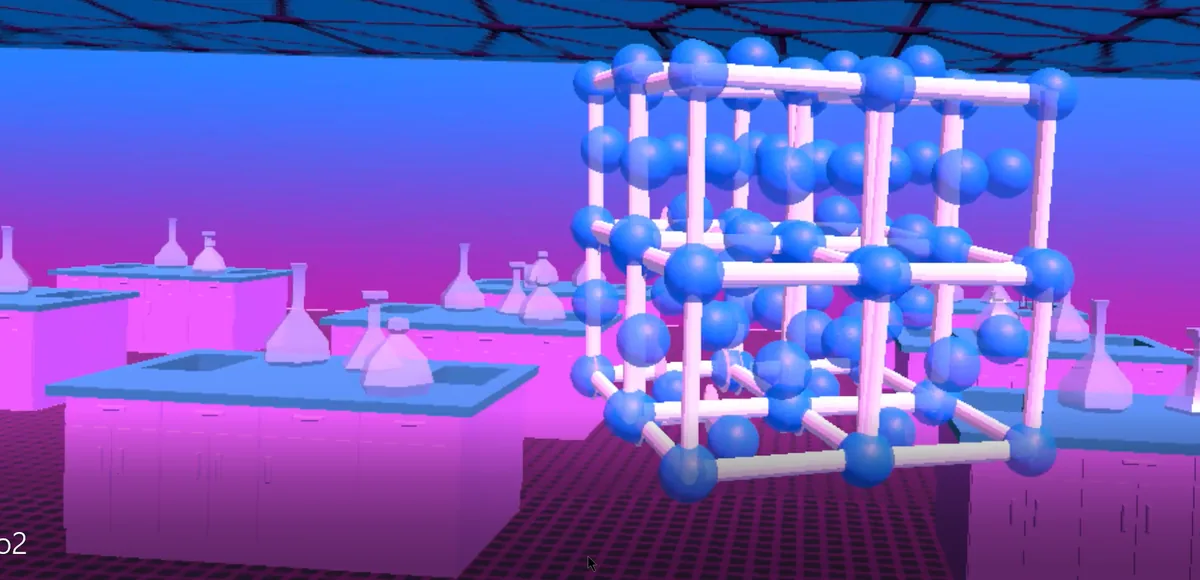
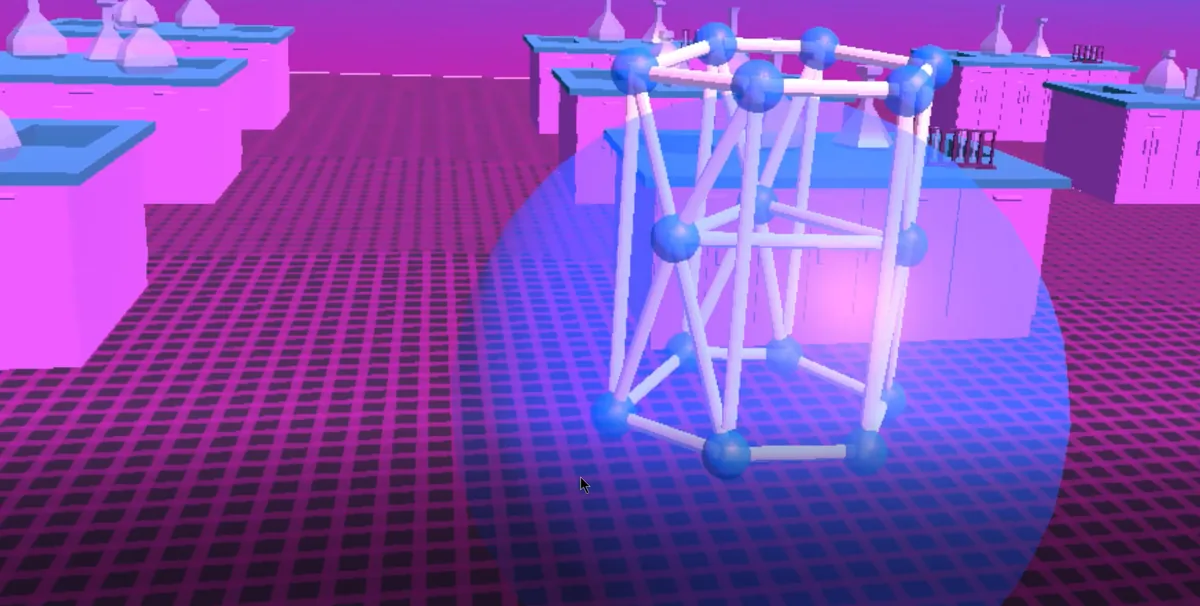
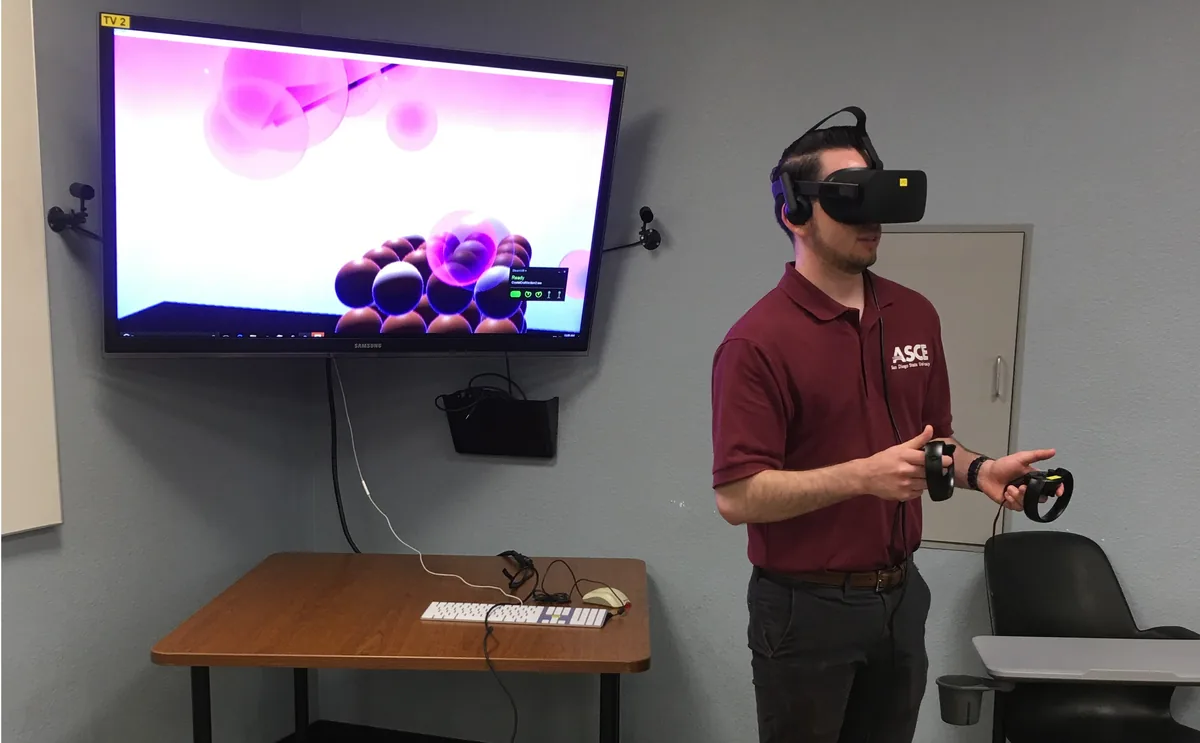
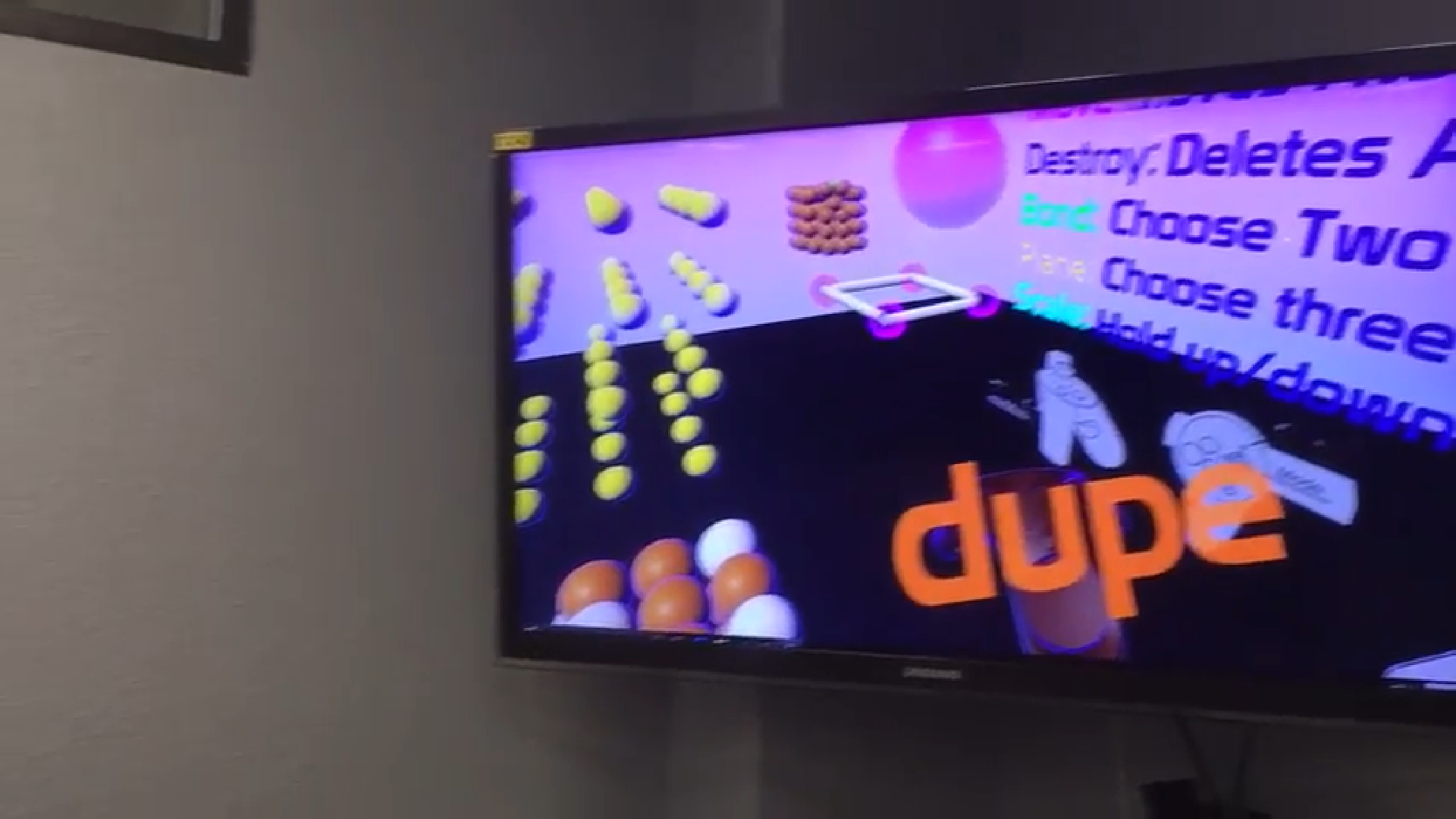
CrystalCraft is an open-source virtual reality application for building atomic models and learning crystal structures at the molecular level. The project turns materials visualization into a calm, creative learning environment developed through an interdisciplinary SDSU student-faculty collaboration.
Build atomic models in virtual reality
Explore crystal structures at the molecular level
Use FCC and HCP examples to support materials instruction
Blend materials science, game design, and open-source development
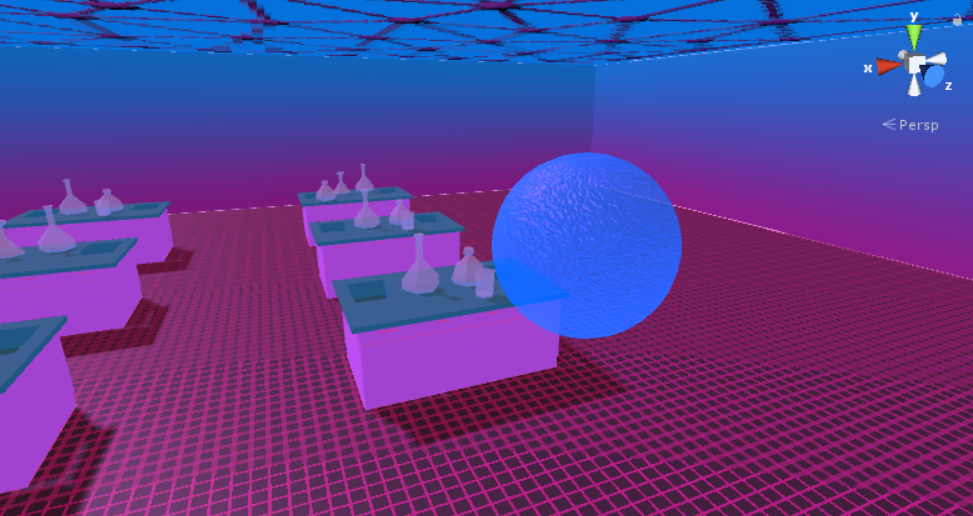
Early footage from the user perspective in the CrystalCraft VR environment.
2x2 FCC arrayHCP structureAtom textureEarly demo environmentCrystalCraft in the VITAL Lab
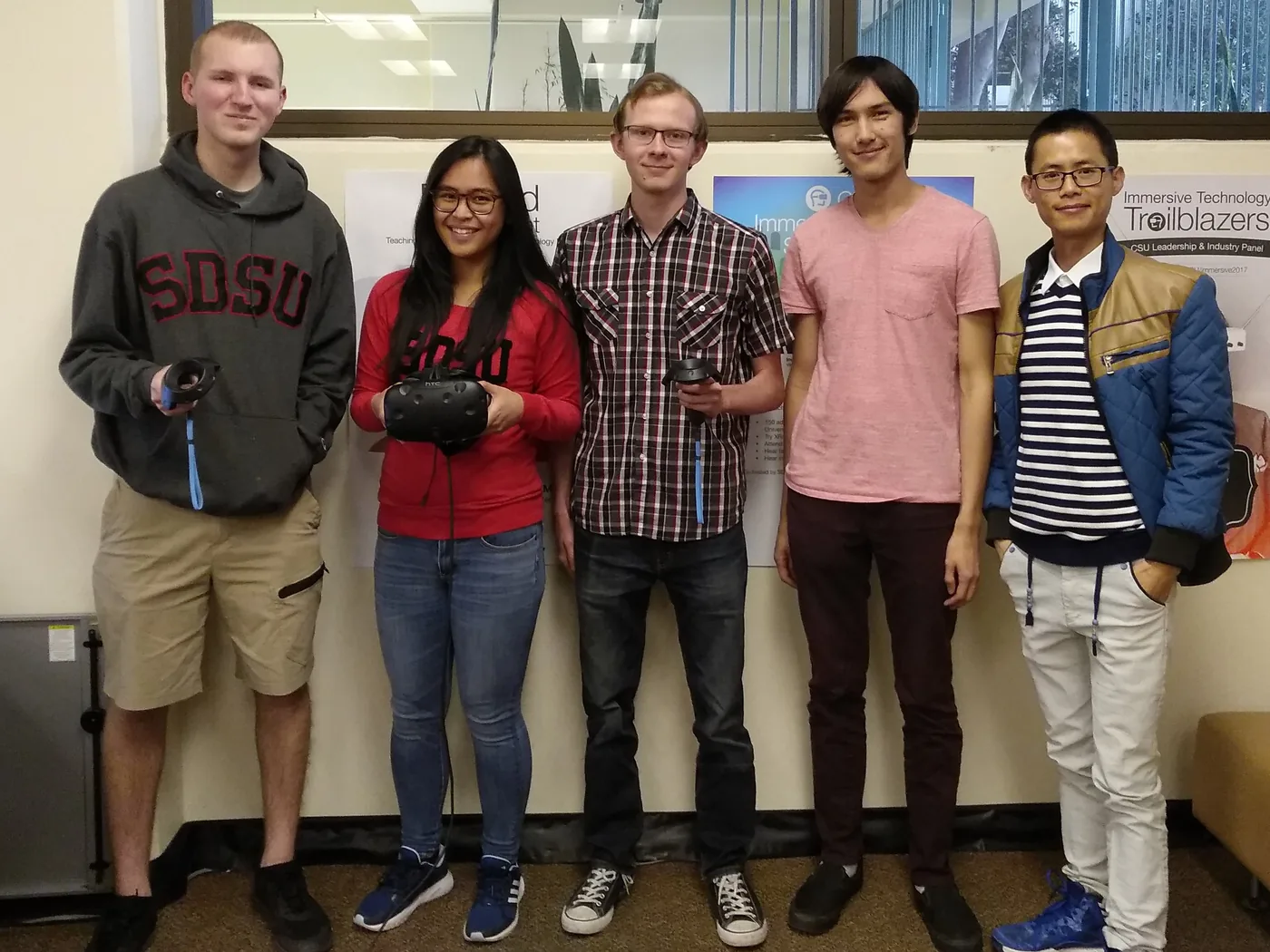
Interdisciplinary SDSU project team
CrystalCraft was created through collaboration across software engineering, game design, mechanical engineering, materials science, 3D modeling, and faculty advising.
Carter AndrewsSoftware engineer, web developer, and game designer
Roselynn ConradyMechanical engineer, content designer, and materials scientist
Patrick PerrineSoftware engineer, game designer, and film maker
Kain KunProgrammer, graphic artist, and 3D modeler
Wenwu XuSDSU faculty advisor and materials simulation specialist
Collaborators
Collaborators and Professional Network - Past and Present.
Meet collaborators, co-authors, advisors, and professional colleagues connected through research, teaching, scientific symposia, committees, and workshops across universities, national laboratories, industry, and research organizations.
Global collaboration map
Interactive OpenStreetMap view of institutional locations for current and past collaborators, co-authors, advisors, and professional network colleagues. Zoom, pan, and select markers for names.
97people68locations9countries
Map data and tiles by OpenStreetMap contributors. Use the plus and minus controls to zoom; drag to pan. Report a map issue
Aachen, GermanyDierk Raabe
Albuquerque, NM, USAJames M. Goff
Alliance, OH, USAChristine Morales
Amherst, NY, USADom Sirianni
Arlington, VA, USACindy Ramboyong, Kate Klemic
Austin, TX, USAJosh Beckham
Badajoz, SpainJuan J. Melendez
Baltimore, MD, USAJoseph Bennett, Marie van Staveren
Baton Rouge, LA, USAHeidi Klem
Beijing, ChinaXiaoyan Song
Berkeley, CA, USAMark Asta, Wibe Albert "Bert" de Jong
Shared infrastructure supporting M3 Lab experiments, simulations, data analysis, and computational materials research.
Experimental Resources
Customized and lab-developed experimental platforms supporting Xu group studies of field-assisted processing, in-situ microscopy, thermal-mechanical coupling, and rapid high-temperature testing.
Real lab image: full benchtop ENP setup with pulsed-current supply, fixture board, measurement electronics, and oscilloscope.Real lab image
Electro-Nano-Pulsing (ENP) Advance 4X Platform
Nanosecond pulsed-current processing for grain-boundary engineering.
The Xu group develops customized electro-nano-pulsing platforms for grain-boundary engineering in metallic materials. The ENP Advance 4X system applies programmable nanosecond-scale current pulses to small metallic specimens to probe localized electrical, thermal, and electron-wind effects at grain boundaries.
Four-pair copper feed-plate architecture on alumina-ceramic PCB
Removable central chamber for inert Ar or liquid-nitrogen operation
Designed for small metallic strip specimens
Supports studies separating Joule-heating and electron-wind effects
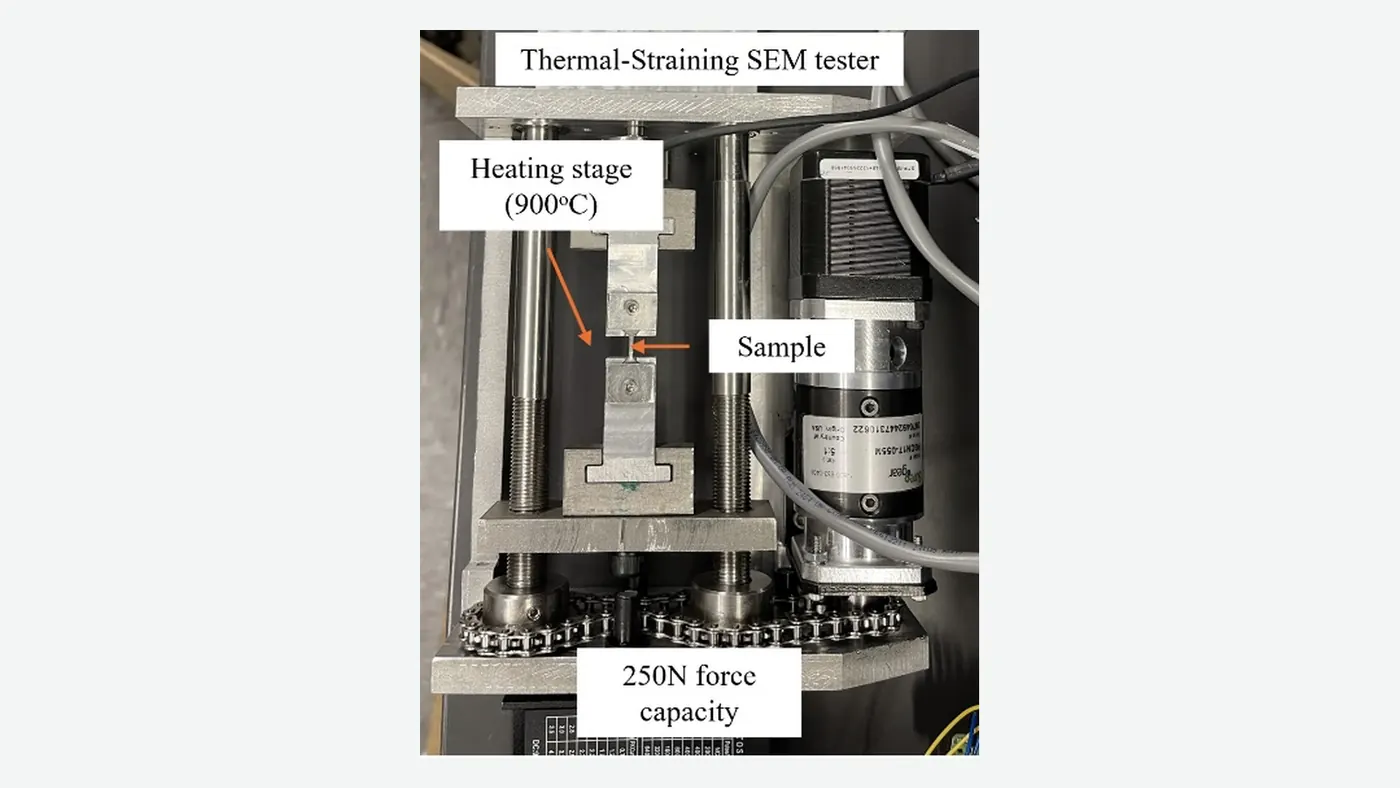
Real lab image: thermal-straining SEM tester with heating stage, sample zone, and mechanical loading hardware.Real lab image
Custom SEM In-Situ Thermo-Mechanical Testing Device
Lab-made fixture for direct SEM observation during thermal-straining.
The group has developed a customized SEM-compatible mechanical testing device for in-situ thermal-straining studies. Paired with an SEM heating stage, the fixture supports direct observation of deformation and microstructural evolution under coupled thermal and mechanical loading.
Lab-made SEM-compatible mechanical fixture
Compatible with in-situ SEM imaging workflows
Pairs with a heating stage for thermal-straining experiments
Supports observation of strain localization, cracking, and interface evolution
Adaptable to customized specimen geometries and loading configurations
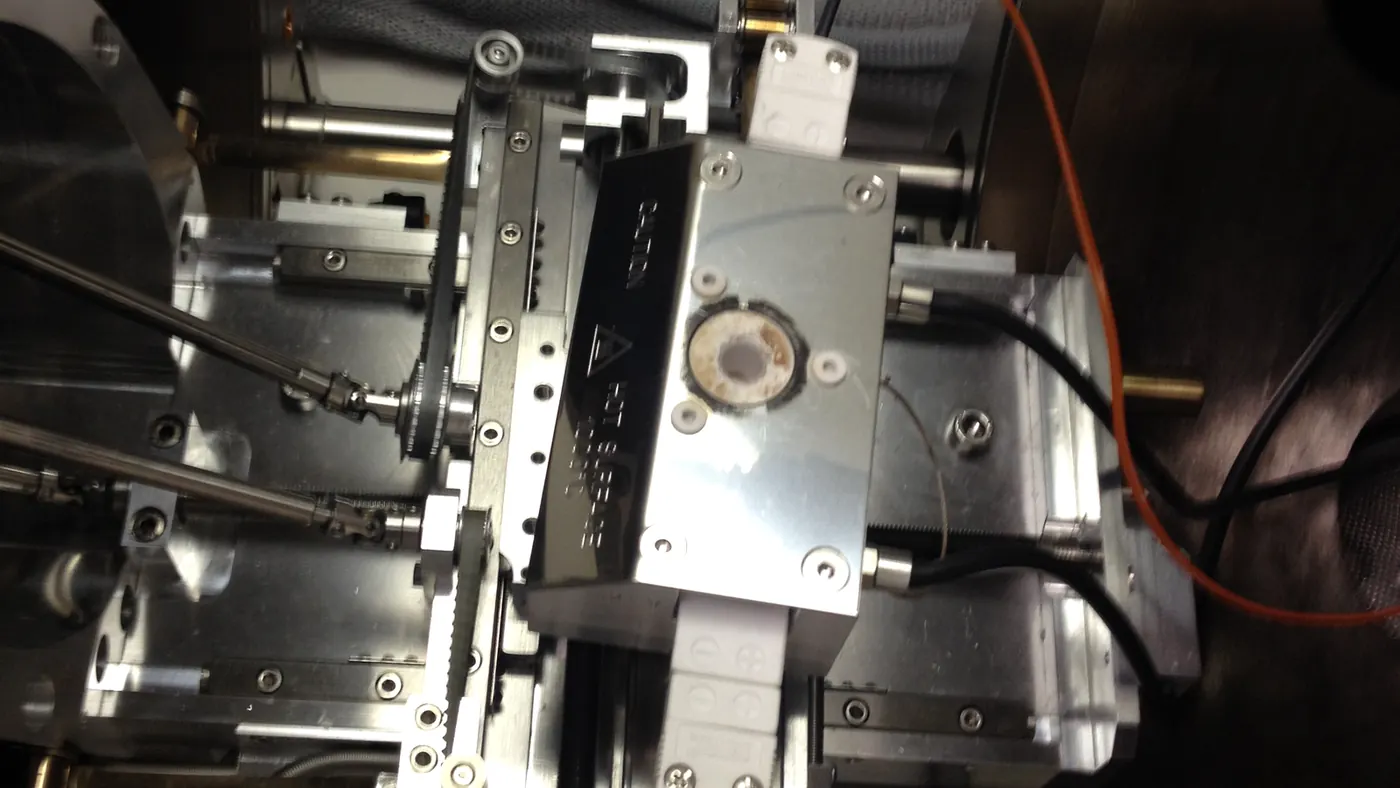
Real lab image: SEM hot-stage assembly installed in the SEM chamber for elevated-temperature experiments.Real lab image
SEM High-Temperature Heating Stage / Furnace Capability
Elevated-temperature SEM observation and thermal-processing studies.
The group uses high-temperature SEM-stage capabilities to observe microstructural evolution during thermal exposure and coupled thermal-mechanical loading. These resources support SEM-based high-temperature and flash-sintering studies of ceramic and metallic materials.
SEM-based observation during controlled heating
Integrates with customized mechanical loading hardware
Supports thermal exposure, thermal-straining, and flash-sintering studies
Tracks morphology, cracking, and grain-boundary behavior
Apreo 2-compatible heating-stage path with detector compatibility considerations
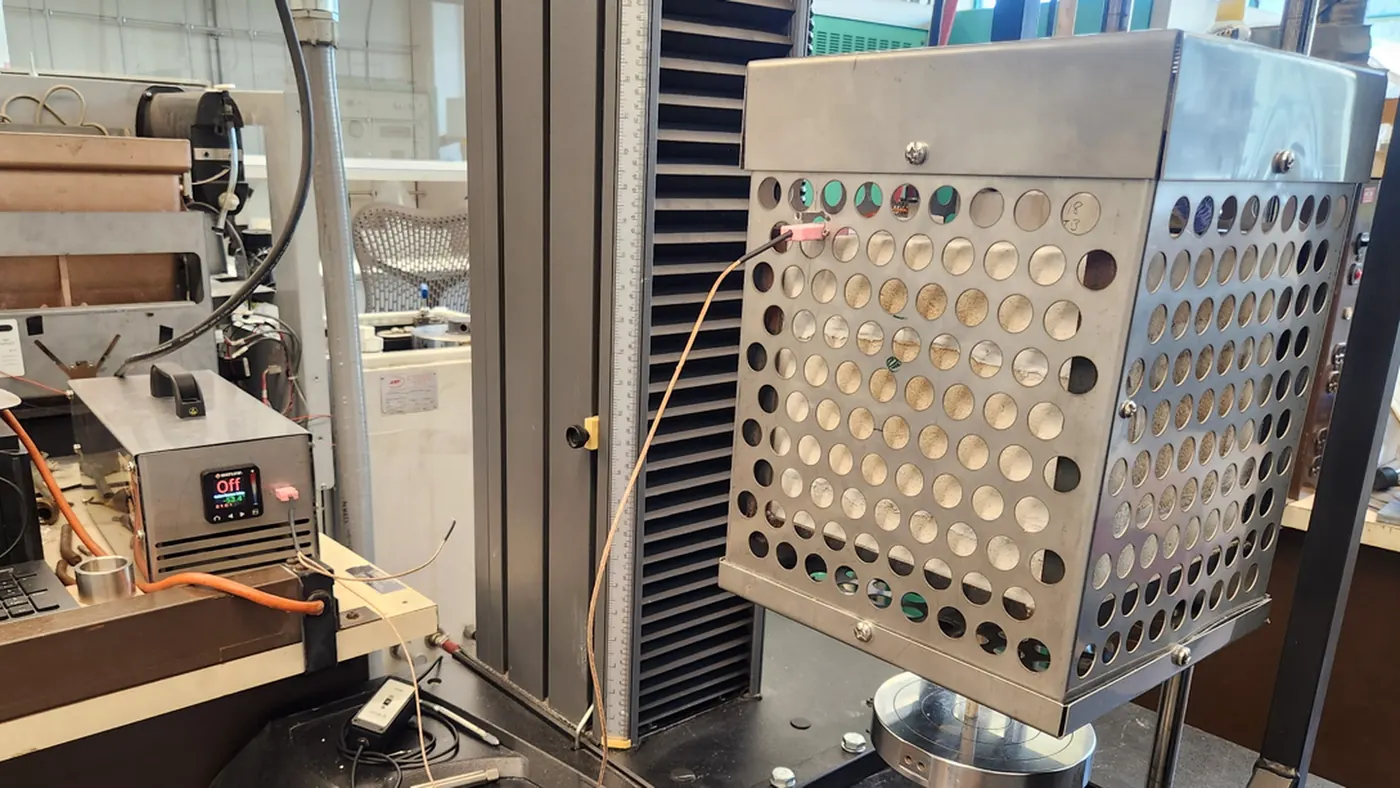
Real lab image: custom rapid-heating furnace integrated with an Instron frame for coupled thermal-mechanical testing.Real lab image
Custom Rapid-Heat Tube Furnace / ENP-Compatible Rapid Heating System Integrated with Mechanical Testing
Fast high-temperature experiments under mechanical loading.
The Xu group operates a custom rapid-heat tube furnace designed for thermal-elastic processing and high-temperature mechanical testing. The system integrates with an Instron universal testing machine to enable coupled heating and mechanical loading of small cylindrical specimens.
Custom-built compact rapid-heat tube furnace
Designed to bolt directly to an Instron universal testing machine
Four silicon-carbide heating elements with SCR power control
Watlow PM6+ PID control with Type N thermocouple
Can also operate as a standalone table-mounted furnace
Computing Resources
The Xu Research Group uses high-performance computing resources at San Diego State University to support computational materials science, atomistic simulations, molecular dynamics, data analysis, and simulation-driven materials design.
SDSU High Performance Computing Cluster
The group uses SDSU High Performance Computing Cluster resources for CPU- and GPU-based computational research. SDSU HPCC infrastructure provides shared high-performance computing nodes, GPU-enabled resources, and networked storage capacity that support large-scale simulations and data-intensive post-processing.
The group also uses SDSU Technology Infrastructure for Data Exploration (TIDE) research cluster. TIDE provides SDSU researchers access to research-class CPU, GPU, and storage resources. These resources support containerized research workflows, including computational materials modeling, atomistic simulations, data analysis, and machine-learning-assisted materials research.

'/%3e%3cg%20transform='translate(140%20150)'%3e%3crect%20x='0'%20y='80'%20width='390'%20height='510'%20rx='34'%20fill='%23ffffff'%20opacity='.94'/%3e%3cg%20stroke='%23a3312b'%20stroke-width='6'%20fill='none'%3e%3cpath%20d='M45%20154%20162%20106l98%2064%2078-14'/%3e%3cpath%20d='M45%20267c88-61%20172-70%20252-27%2024%2013%2048%2020%2072%2021'/%3e%3cpath%20d='M45%20421c75-41%20146-41%20214%200%2045%2027%2085%2030%20121%2010'/%3e%3c/g%3e%3cg%20fill='%231b7c7a'%3e%3ccircle%20cx='86'%20cy='516'%20r='18'/%3e%3ccircle%20cx='166'%20cy='486'%20r='14'/%3e%3ccircle%20cx='248'%20cy='535'%20r='20'/%3e%3ccircle%20cx='320'%20cy='484'%20r='13'/%3e%3c/g%3e%3cg%20stroke='%23ffffff'%20stroke-width='5'%20stroke-opacity='.52'%20fill='none'%3e%3cpath%20d='M430%20180h230'/%3e%3cpath%20d='M430%20336h230'/%3e%3cpath%20d='M430%20500h230'/%3e%3cpath%20d='M790%20220h210'/%3e%3cpath%20d='M790%20462h210'/%3e%3c/g%3e%3cg%20fill='%23ffffff'%3e%3ccircle%20cx='690'%20cy='180'%20r='34'/%3e%3ccircle%20cx='690'%20cy='336'%20r='34'/%3e%3ccircle%20cx='690'%20cy='500'%20r='34'/%3e%3ccircle%20cx='760'%20cy='220'%20r='34'/%3e%3ccircle%20cx='760'%20cy='462'%20r='34'/%3e%3ccircle%20cx='1032'%20cy='220'%20r='42'/%3e%3ccircle%20cx='1032'%20cy='462'%20r='42'/%3e%3c/g%3e%3cg%20fill='%23d64235'%3e%3ccircle%20cx='690'%20cy='180'%20r='13'/%3e%3ccircle%20cx='690'%20cy='336'%20r='13'/%3e%3ccircle%20cx='690'%20cy='500'%20r='13'/%3e%3ccircle%20cx='760'%20cy='220'%20r='13'/%3e%3ccircle%20cx='760'%20cy='462'%20r='13'/%3e%3c/g%3e%3crect%20x='1120'%20y='134'%20width='250'%20height='390'%20rx='28'%20fill='%23ffffff'%20opacity='.94'/%3e%3cg%20stroke='%231b7c7a'%20stroke-width='9'%20fill='none'%3e%3cpath%20d='M1162%20462c44-186%2093-249%20144-190%2019%2023%2038%2055%2057%2096'/%3e%3cpath%20d='M1162%20364h184'/%3e%3cpath%20d='M1162%20278h184'/%3e%3c/g%3e%3c/g%3e%3c/svg%3e)
'/%3e%3cg%20opacity='.42'%20stroke='%23ffffff'%20stroke-width='5'%20fill='none'%3e%3cpath%20d='M65%20238%20238%2083l246%2072%20111%20222-177%20180-267-60Z'/%3e%3cpath%20d='M484%20155%20743%2070l225%20127-23%20272-350-92Z'/%3e%3cpath%20d='M968%20197%201220%20100l261%20156-104%20253-432-40Z'/%3e%3cpath%20d='M151%20497%20418%20557l110%20284-251%2095-206-182Z'/%3e%3cpath%20d='M418%20557%20595%20377l350%2092%2082%20263-290%20178-209-69Z'/%3e%3cpath%20d='M1027%20732%201377%20509l167%20216-174%20211-343-24Z'/%3e%3c/g%3e%3cg%20stroke='%235fd2cd'%20stroke-width='4'%20stroke-opacity='.5'%20fill='none'%3e%3cpath%20d='M238%2083%20418%20557'/%3e%3cpath%20d='M743%2070%20737%20910'/%3e%3cpath%20d='M1220%20100%201027%20912'/%3e%3c/g%3e%3cpath%20d='M126%20748c192-32%20336-78%20434-141%20111-72%20142-166%20254-225%20126-67%20318-55%20660-174'%20fill='none'%20stroke='url(%23pulse)'%20stroke-width='42'%20stroke-linecap='round'%20filter='url(%23glow)'/%3e%3cpath%20d='M128%20748c196-31%20341-77%20437-139%20109-70%20141-165%20253-224%20124-66%20317-54%20657-173'%20fill='none'%20stroke='%23ffffff'%20stroke-width='9'%20stroke-linecap='round'%20opacity='.9'/%3e%3cg%20fill='%23d64235'%20opacity='.88'%3e%3ccircle%20cx='292'%20cy='704'%20r='18'/%3e%3ccircle%20cx='560'%20cy='607'%20r='14'/%3e%3ccircle%20cx='816'%20cy='383'%20r='16'/%3e%3ccircle%20cx='1186'%20cy='275'%20r='20'/%3e%3c/g%3e%3cg%20fill='%23ffffff'%20opacity='.78'%3e%3ccircle%20cx='90'%20cy='160'%20r='5'/%3e%3ccircle%20cx='1430'%20cy='128'%20r='6'/%3e%3ccircle%20cx='1300'%20cy='842'%20r='5'/%3e%3ccircle%20cx='430'%20cy='290'%20r='6'/%3e%3c/g%3e%3c/svg%3e)
'/%3e%3cg%20transform='translate(214%20170)'%3e%3crect%20x='0'%20y='224'%20width='242'%20height='116'%20rx='20'%20fill='%232a3034'/%3e%3crect%20x='928'%20y='224'%20width='242'%20height='116'%20rx='20'%20fill='%232a3034'/%3e%3cpath%20d='M242%20282h154'%20stroke='%2359666a'%20stroke-width='28'%20stroke-linecap='round'/%3e%3cpath%20d='M774%20282h154'%20stroke='%2359666a'%20stroke-width='28'%20stroke-linecap='round'/%3e%3crect%20x='394'%20y='84'%20width='382'%20height='396'%20rx='46'%20fill='url(%23hot)'%20stroke='%23ffffff'%20stroke-width='14'/%3e%3cg%20fill='none'%20stroke='%23ffffff'%20stroke-width='8'%20opacity='.72'%3e%3cpath%20d='M470%20124c-38%2092-25%20176%2039%20253'/%3e%3cpath%20d='M585%20104c-33%20119-19%20238%2045%20356'/%3e%3cpath%20d='M698%20125c-46%2088-55%20185-19%20293'/%3e%3c/g%3e%3cg%20fill='%23ffffff'%20opacity='.92'%3e%3ccircle%20cx='470'%20cy='412'%20r='15'/%3e%3ccircle%20cx='540'%20cy='180'%20r='12'/%3e%3ccircle%20cx='638'%20cy='282'%20r='17'/%3e%3ccircle%20cx='716'%20cy='384'%20r='13'/%3e%3ccircle%20cx='612'%20cy='438'%20r='10'/%3e%3c/g%3e%3cg%20stroke='%231b7c7a'%20stroke-width='10'%20stroke-linecap='round'%20fill='none'%3e%3cpath%20d='M116%20190c80-84%20179-125%20298-124'/%3e%3cpath%20d='M1054%20190c-82-82-184-123-305-122'/%3e%3cpath%20d='M142%20394c73%2077%20162%20117%20269%20119'/%3e%3cpath%20d='M1028%20394c-78%2075-170%20114-278%20117'/%3e%3c/g%3e%3c/g%3e%3cg%20fill='%23171c1f'%20opacity='.08'%3e%3ccircle%20cx='180'%20cy='150'%20r='74'/%3e%3ccircle%20cx='1420'%20cy='812'%20r='102'/%3e%3c/g%3e%3c/svg%3e)
'/%3e%3cg%20transform='translate(355%20165)'%3e%3cg%20opacity='.92'%3e%3cpath%20d='M180%20500%20680%20650%20970%20476%20462%20324Z'%20fill='%238fa09e'/%3e%3cpath%20d='M180%20420%20680%20570%20970%20396%20462%20244Z'%20fill='url(%23grain)'%20stroke='%23ffffff'%20stroke-width='7'/%3e%3cpath%20d='M180%20340%20680%20490%20970%20316%20462%20164Z'%20fill='url(%23grain)'%20stroke='%23ffffff'%20stroke-width='7'/%3e%3cpath%20d='M180%20260%20680%20410%20970%20236%20462%2084Z'%20fill='url(%23grain)'%20stroke='%23ffffff'%20stroke-width='7'/%3e%3c/g%3e%3cg%20fill='none'%20stroke='%23a3312b'%20stroke-width='9'%20stroke-linecap='round'%20opacity='.75'%3e%3cpath%20d='M386%20230c80-21%20150-10%20210%2033%2052%2037%20120%2047%20204%2029'/%3e%3cpath%20d='M344%20402c76-22%20154-6%20233%2048%2054%2036%20118%2044%20193%2024'/%3e%3c/g%3e%3cg%20fill='%231b7c7a'%3e%3ccircle%20cx='725'%20cy='208'%20r='16'/%3e%3ccircle%20cx='560'%20cy='350'%20r='15'/%3e%3ccircle%20cx='798'%20cy='468'%20r='18'/%3e%3c/g%3e%3c/g%3e%3cg%20transform='translate(116%20138)'%20stroke='%23171c1f'%20stroke-width='9'%20fill='none'%20opacity='.65'%3e%3ccircle%20cx='120'%20cy='120'%20r='82'/%3e%3cpath%20d='m181%20181%2094%2094'/%3e%3cpath%20d='M76%20120h88M120%2076v88'/%3e%3c/g%3e%3c/svg%3e)




























 Project site
 GitHub repository